




Abstract
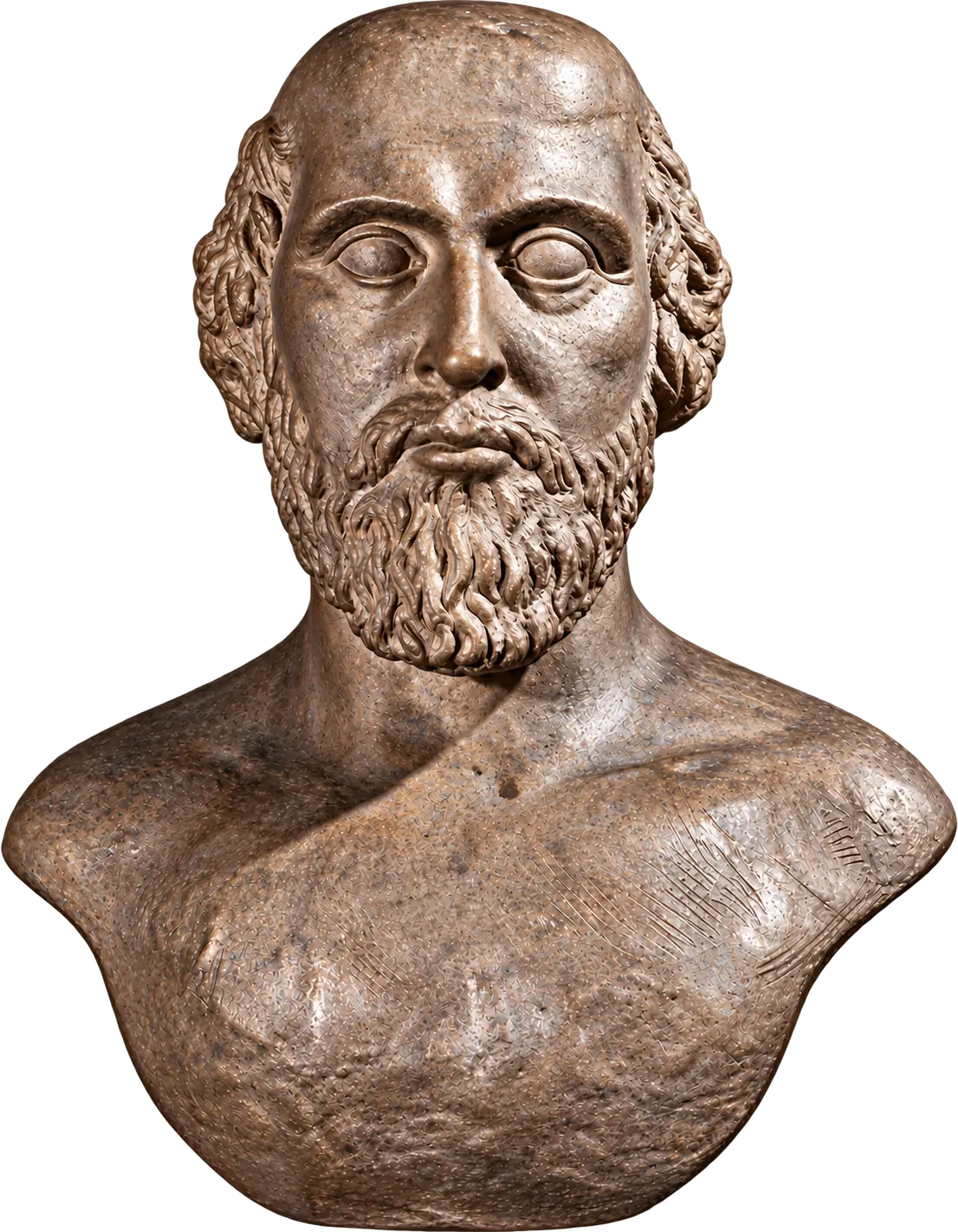
Alcmaeon of Croton, who most probably lived at the end of the 6th and the beginning of the 5th century BC, holds a special place in the history of ideas about the human being, because ancient tradition attributes to him an early and explicit connection of the senses with the brain, as well as the distinction between sensation and human understanding. The significance of these positions is great, but the surviving evidence is extremely limited and mostly indirect. The present text critically examines what can be supported about his life and work, his method, the functioning of the senses, the role of the brain, the theory of the soul and the definition of health as an isonomia of powers. The main conclusion is that Alcmaeon can justifiably be regarded as the earliest known Greek thinker to whom the systematic connection of all the senses with the brain is attributed. It is not documented, however, that he discovered the nervous system, that he carried out systematic human dissections or that he formulated a complete neuroscientific theory in the modern sense.
Introduction
Why does Alcmaeon concern us today? Evidently because the first explicit connection of the senses and of human understanding with the brain is attributed to him — an idea very different in form, but akin in substance, to today's view that the organ of the mind resides there.
The historical significance of Alcmaeon lies at the point where early physiology, philosophical inquiry into knowledge and the medical interpretation of the human body intersect. This position makes him particularly interesting for the history of psychology: the testimonies concerning him are not confined to individual sensory functions, but touch on the difference between perceiving and understanding, the relation of the brain to the sensory pathways and the limits of human knowledge. At the same time, the material is so fragmentary that every modern synthesis must strictly distinguish the authentic fragment, the ancient paraphrase and the later interpretation.
Very little continuous authentic wording of his work survives: about three lines of one fragment and half a line of another, while most of what he wrote is known to us from later authors. This means that the researcher does not have before them a coherent treatise of his, but a set of uneven testimonies. Theophrastus, Aristotle, Aetius, Calcidius and other authors transmit information from different periods, with different interests and different degrees of proximity to the lost work.[1]
The necessary caution does not diminish the importance of Alcmaeon. On the contrary, it allows the truly strong core of his contribution to be isolated from later titles such as “father of anatomy” or “father of neuroscience”. These labels are rhetorical and conflate an early theoretical breakthrough with the much later anatomical demonstration of the nervous system.
Notes:
1. On the extremely limited extent of the verbatim fragments and the distinction between fragments and testimonies, see Huffman 2025, section 1.4.
The sources and the limits of reconstruction
Ancient tradition attributes to Alcmaeon a book that bore the conventional title Περὶ φύσεως (On Nature). The title is probably a later classificatory habit for the works of the Presocratics rather than an authentic title given by the author. The book seems to have still been available in the fourth century BC, since Theophrastus provides a detailed account of the senses and Aristotle had written a work Πρὸς τὰ Ἀλκμαίωνος (Against Alcmaeon). The loss of the original, however, makes the distinction between the fragments regarded as verbatim and the testimonia — that is, the ancient reports or paraphrases — crucial.[2]
This distinction directly affects the language of research. It is not accurate to write, without qualification, that “Alcmaeon said” something we know only from Theophrastus or Aristotle. Safer are the formulations “Theophrastus attributes to Alcmaeon” and “according to the Aristotelian testimony”. In this way the historical value of the information is preserved without turning an indirect source into verbatim speech.
| Central position | Certainty | Safe formulation |
|---|---|---|
| Connection of the senses and the brain | High | Ancient tradition explicitly attributes to Alcmaeon the view that all the senses are connected with the brain. |
| Distinction between sensation and understanding | High | According to Theophrastus, animals perceive, whereas humans in addition understand. |
| Systematic anatomy | Not documented | Possibly limited observation or excision of an animal's eye, not a programme of human dissections. |
| Discovery of the nervous system | Not documented | The poroi (passages) cannot be identified without reservation with the anatomical nerves. |
| Health as isonomia | High | He attributes health to the balance of opposing powers and disease to the predominance of one. |
Notes:
2. The traditional title Περὶ φύσεως (On Nature) most probably does not go back to Alcmaeon himself; see Huffman 2025, section 1.4.
Dating, the identity of Alcmaeon and his relation to the Pythagorean tradition
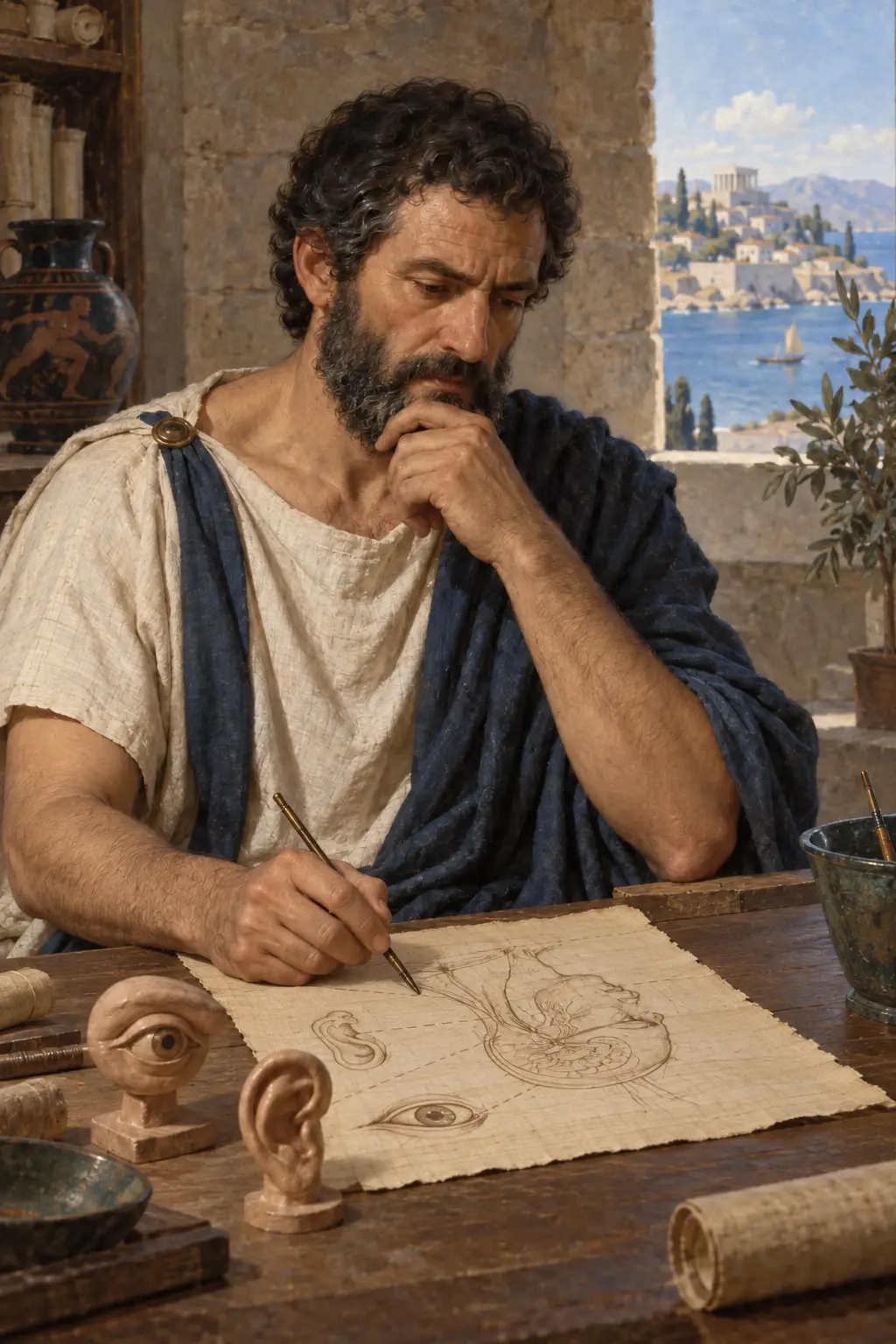
The dating of Alcmaeon remains uncertain. Recent proposals usually place his activity or writing from the end of the sixth to the first half of the fifth century BC, with a probable range for his book of roughly between 500 and 450 BC (Huffman 2025, section 1.3). The uncertainty stems from problematic or ambiguous ancient indications and does not allow a precise biographical dating.
We need to show similar caution in describing him as a physician. His keen interest in physiology, the senses, health and embryology undoubtedly links him with the medical tradition of Croton. We have, however, no direct evidence of an organised clinical practice. The description “physician and philosopher” works as a useful summary, provided that it is not presented as a certain professional identity in the later sense.
His inclusion among the Pythagoreans is also disputed. Ancient tradition is not unanimous, and Aristotle distinguishes Alcmaeon from the Pythagoreans when comparing their theories of opposites. The majority of recent research treats him as an independent figure who knew the Pythagorean milieu of Croton, without it being possible to regard him safely as a member of a single school.[3]
Notes:
3. On the recent tendency to regard him as independent of the Pythagoreans, despite his familiarity with the same Crotoniate milieu, see Huffman 2025, section 1.2.
Knowledge, inquiry and inference (tekmairesthai)
The one surviving fragment of his work is the most solid point for Alcmaeon's epistemological position. There, the clarity that belongs to the gods is contrasted with the human condition of inquiry and inference. Humans do not possess immediate and complete certainty. They must infer from signs and indications. This position is important because it links the recognition of cognitive limits with a positive process of inquiry rather than with a renunciation of knowledge.
The term tekmairesthai (to infer from evidence) allows us to speak of an inferential method, but not to attribute to Alcmaeon a fully developed methodology. The formulation “an early methodology of drawing conclusions from evidence” is more accurate than the anachronistic label “empiricist” without further explanation. The same caution applies to concepts such as experiment, prognosis and scientific method, which can be used only when their historical distance from modern concepts is clearly defined.
Sensation, understanding and the brain
The strongest testimony to Alcmaeon's contribution comes from Theophrastus. In De sensibus 25 it is reported that Alcmaeon differs from other thinkers with regard to the human being: the other animals perceive but do not understand, whereas in humans understanding is distinguished from sensation. This formulation introduces a functional distinction between the reception of sensory data and a higher cognitive capacity. For the history of psychology, this is the central breakthrough in his thought.[4]
In the same Theophrastean account, all the senses are connected in some way with the brain. Hearing, smell, taste and sight are described with their own particular mechanisms, but they converge on a cerebral centre. When the brain is moved or its position changes, the senses can be impeded, precisely because the passages (poroi) through which they operate are affected. The explanation is primitive from the standpoint of today's neurophysiology, but it expresses a coherent causal idea: sensory function depends on the connection between the sense organs and the brain.
The term “poroi” requires care. It may denote passages or channels, but it must not automatically be translated as “nerves”. For hearing and smell it could refer to visible cavities, such as the auditory canal and the nasal passages. In the case of sight, the hypothesis of a structure behind the eye is stronger, but even here the identification with the optic nerve remains an interpretation and not an anatomically described discovery.[5]
The position that the brain is “the seat of thought” is a reasonable synthesis of the testimonies, especially when the distinction between understanding and sensation is combined with the cerebral convergence of the senses. It must be acknowledged, however, that no verbatim statement of his own with this exact wording survives. Even more so, the phrase that “the brain creates the mind”, put forward by Doty (2007), is a strong modern interpretation and not a translation of an ancient fragment.[6]
Notes:
4. Theophrastus, De sensibus 25. The testimony is transmitted as a Theophrastean account of the theory and not as a verbatim fragment from Alcmaeon's work.
5. On the meaning and uncertainty of the poroi, see Huffman 2025, sections 2.3–2.4; Lopez 2025, 58–61; Panegyres and Panegyres 2016, 22–23.
6. The title of Doty 2007 attributes to Alcmaeon the discovery that the brain “creates mind”. The formulation has great interpretive force, but is broader than the surviving ancient evidence.
Anatomical observation and its limits
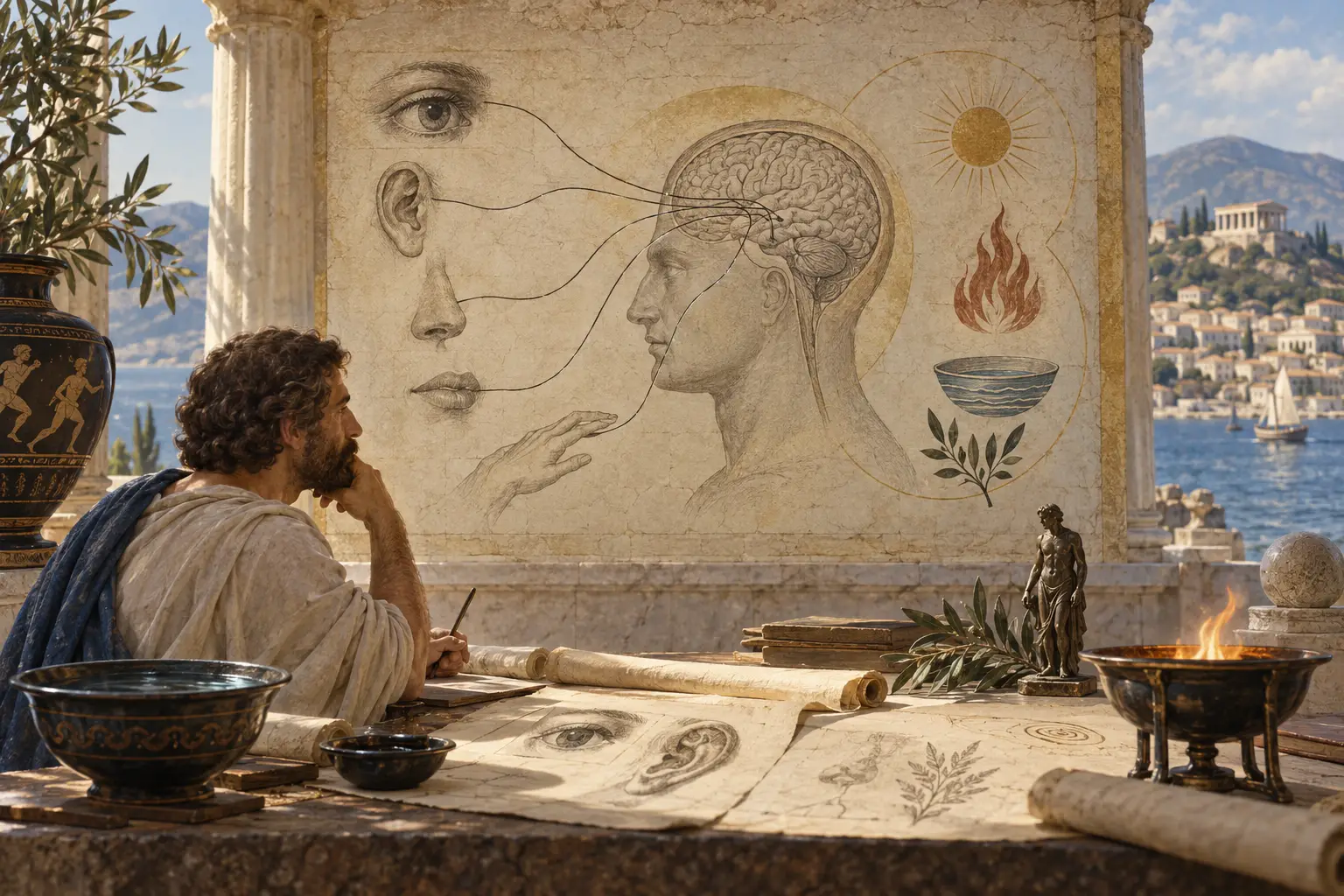
Calcidius reports that Alcmaeon was the first to venture an excision and that his research concerned the nature of the eye. The testimony has been used to support the claim that Alcmaeon performed dissections. The safest reconstruction is much narrower: perhaps he carried out a limited excision or examination of an animal's eye, in order to observe internal structures and a possible direction towards the brain. There is no sufficient basis for systematic dissections of whole bodies, and even less for human dissections.[7]
This distinction is essential for the history of anatomy. The clear anatomical differentiation of sensory and motor nerves and the experimental demonstration of a nervous system are associated with Herophilus in Hellenistic Alexandria, several centuries later. Alcmaeon belongs to the prehistory of this development, not to its mature anatomical stage. His contribution lies in the theoretical connection of the sense organs with the brain, not in the complete anatomical mapping of the nervous system.
For the same reason, the titles “discovered the nervous system” and “father of anatomy” should be avoided. They go beyond the evidence and blur the difference between an early physiological line of reasoning and an anatomical science based on systematic observation, nomenclature and repeatable demonstration.
Notes:
7. Calcidius, In Timaeum 237. On the limited possible examination of an eye and the rejection of systematic dissection, see Huffman 2025, section 2.3; Lopez 2025, 58.
The soul and the question of immortality
Aristotle attributes to Alcmaeon one of the earliest recorded Greek arguments for the immortality of the soul. The soul is considered immortal because it resembles the immortal heavenly bodies in its ceaseless motion. The analogy between the soul and the moving heavenly bodies is cosmological and kinetic, not neuroanatomical.[8]
Therefore, the argument for immortality should not be confused with the theory of the brain. We have no reliable testimony that Alcmaeon located the soul in the brain. The connection of the brain with sensation and understanding does not automatically imply that the soul was conceived as a localised anatomical entity. The opposite position, which appears in some modern syntheses of medical history, turns a possible relation into a certain theory.
Likewise, there is no basis for attributing to Alcmaeon a Cartesian dualism of mind and body. The distinction between sensation and understanding concerns functions and cognitive capacities, not two independent substances. The use of later psychological or philosophical categories is legitimate only as a comparative tool, provided that it is clearly stated that the concepts are not identical.
Notes:
8. Aristotle, De anima I 2, 405a29–b1. The Aristotelian presentation links the soul with ceaseless motion and not with a specific anatomical location.
Health, disease and the isonomia of powers
The second major contribution attributed to Alcmaeon concerns the definition of health and disease. Health consists in the isonomia (equality of rights) of the opposing powers — the wet and the dry, the hot and the cold, the bitter and the sweet, and others — whereas the monarchia (sole rule) of one of them produces disease. Health is also described as a proportionate blending (krasis) of the qualities. The theory is one of the earliest surviving general explanations of health as a dynamic equilibrium.
The so-called fragment B4 cannot safely be treated as a verbatim phrase of Alcmaeon. It is a doxographical testimony, and the precise historical stratigraphy of its political terminology has been discussed at length. Nevertheless, the basic core — the balance of many powers as opposed to the destructive predominance of one — is considered strongly connected with his thought.[9]
The political metaphor is essential. Isonomia does not simply denote a static equality of quantities, but an order in which no power acquires exclusive dominance. Disease, correspondingly, is not merely a lack of balance; it is monarchia, that is, one-sided rule within the body. With this language the body becomes a field of regulated relations. This idea deeply influenced later medical thought, without this meaning that every theory of balance in the Hippocratic corpus depends directly and demonstrably on Alcmaeon.
Notes:
9. On the philological and historical discussion of the so-called B4, see Grimaudo 2025, 51–56; Huffman 2025, section 3.1.
Embryology, development and specific reconstructions
Ancient doxographical sources attribute to Alcmaeon views on the origin of semen, embryonic development, sleep and death. In particular, he has been associated with an encephalomyelogenic theory of semen, according to which semen originates from the brain or the marrow. This attribution is interesting for the coherence of a broader brain-centred physiology, but its precise form and authenticity remain uncertain.
The recent study by Cilione (2025) examines the long connection between this theory, puberty, intellectual maturation and later medical and legal classifications of age. Its contribution is important for the history of reception, not as direct proof of a complete Alcmaeonian psycho-developmental theory. The chains of transmission are indirect and pass through multiple conceptual and institutional settings.
Influence and later reception
Alcmaeon's influence can be discerned both in ancient philosophy and in medicine. The fact that Aristotle wrote a special work against, or in response to, his positions shows that in the fourth century BC he was regarded as a significant interlocutor. Plato and Philolaus also, according to recent research, accepted brain-centred positions, without this always allowing a certain direct genealogy.
The affinities with the Hippocratic corpus are significant, particularly regarding the balance of powers and the role of the brain. However, the term “influence” must be used with gradation. Shared questions, a shared geographical and intellectual environment or parallel development can also explain similarities. Gambetti's (2025) proposal of a possible influence on Parmenides is an interesting specific hypothesis, but the dating and the direction of the relationship have not been proven.
Similar caution is required by Lopez's (2025) proposal of an Egyptian influence on the Alcmaeonian theory of the senses and the poroi. The comparative reading of the Theophrastean testimony alongside Egyptian traditions brings out possible analogies and a more widely interconnected Mediterranean environment. The analogies, however, do not in themselves prove direct transmission or a specific historical channel.[10]
In more recent historiography, Alcmaeon is often presented in terms of a forerunner of neuroscience. This presentation has pedagogical value, provided that it is stated that it is a retrospective placement. Allbutt (1918), commenting on Stratton's study of physiological psychology before Aristotle, provides evidence of this older history of reception and not an independent primary source on Alcmaeon.
Notes:
10. The comparative hypothesis is developed in Lopez 2025. Similarity between traditions is an indication to be investigated, not independent proof of historical borrowing.
Conclusion
The safest historical assessment is at once more limited and more substantial than the usual honorary titles. Alcmaeon is the earliest known Greek thinker to whom the surviving ancient tradition explicitly attributes the connection of all the senses with the brain. In the same context, human understanding is distinguished from mere sensation. These two positions form a core of great significance for the history of psychology, because they link the cognitive distinctiveness of the human being with a bodily, and more specifically cerebral, organisation.
There is no need to turn Alcmaeon into a modern neuroscientist in order to recognise his originality. The discovery of the nervous system, systematic human dissections, the anatomical localisation of the soul in the brain or a Cartesian dualism are not documented. The possible examination of the eye and the theory of the poroi show observational boldness, but they must remain at the level that the testimony allows.
The theory of isonomia adds a second dimension: the organism is conceived as a balance of many powers and disease as a one-sided predominance. Together with inference from evidence and the recognition of the limits of human knowledge, this theory shows a thinker who tried to explain the human being through coherent natural relations. His historical significance lies precisely in this shift: not in possessing the modern answer, but in formulating questions and connections that made possible a new inquiry into the body, sensation and thought.
Bibliography
Allbutt, C. (1918). Theophrastus and the Greek physiological psychology before Aristotle. The Classical Review, 32(5–6), 117–120. https://doi.org/10.1017/S0009840X00011628
Celesia, G. G. (2012). Alcmaeon of Croton’s observations on health, brain, mind, and soul. Journal of the History of the Neurosciences, 21, 409–426. https://doi.org/10.1080/0964704X.2011.626265
Cilione, M. (2025). Seed from the brain: Sexual and cognitive development from childhood to adolescence in Greek and Roman antiquity. Medicina nei Secoli, 37(3), 13–30. https://doi.org/10.13133/2531-7288/3180
Cilione, M., & Gambetti, F. (2025). Introduction: Alcmaeon of Croton between medicine and philosophy. Medicina nei Secoli, 37(3), 5–12. https://doi.org/10.13133/2531-7288/3179
Debernardi, A., Sala, E., D’Aliberti, G., Talamonti, G., Franchini, A. F., & Collice, M. (2010). Alcmaeon of Croton. Neurosurgery, 66, 247–252. https://doi.org/10.1227/01.NEU.0000363193.24806.02
Doty, R. W. (2007). Alkmaion’s discovery that brain creates mind: A revolution in human knowledge comparable to that of Copernicus and of Darwin. Neuroscience, 147, 561–568. https://doi.org/10.1016/j.neuroscience.2007.02.046
Gambetti, F. (2025). Knowledge and perceptions between Alcmaeon and Parmenides. Medicina nei Secoli, 37(3), 31–50. https://doi.org/10.13133/2531-7288/3181
Grimaudo, S. (2025). Again on fragment 4 D.-K.: Alcmaeon and Galen compared. Medicina nei Secoli, 37(3), 51–56. https://doi.org/10.13133/2531-7288/3182
Huffman, C. A. (2025). Alcmaeon. The Stanford Encyclopedia of Philosophy. Substantive revision 18 July 2025.
Lopez, F. (2025). New remarks on the relationship between Alcmaeon and the Egyptian medical tradition. Medicina nei Secoli, 37(3), 57–80. https://doi.org/10.13133/2531-7288/3183
Panegyres, K. P., & Panegyres, P. K. (2016). The Ancient Greek discovery of the nervous system: Alcmaeon, Praxagoras and Herophilus. Journal of Clinical Neuroscience, 29, 21–24. https://doi.org/10.1016/j.jocn.2015.10.047